
Year-Long Customer Satisfaction Survey Results: Buick Lags, Ram Recovers, Toyota Leads
Given their popularity, it might come as a surprise to find that the ASCI, or American Customer Satisfaction Index, found GM's entire brand range to have underperformed quite significantly in its 2026 survey. Compared to last year, Cadillac's score fell from 81 to 69 (a 15% drop), GMC dropped 6% (81 to 76), and Chevrolet dropped 5%, going from 79 to 75. However, Buick saw the most dramatic fall in customer satisfaction scores, going from 81 to 68 — a 16% year-on-year drop. ASCI cites tariffs and a lack of EVs as possible reasons.
Leading the mass-market pack is Toyota with a score of 83, while Subaru trails in second despite its score dropping 5% from last year. Honda, Hyundai, and Kia round out the top five (in that order), while Ford, Mazda, and Nissan complete the midfield.
Although much of Stellantis is still at the bottom, just like in 2025, some of its portfolio brands have seen improvements, with Ram posting the largest year-on-year gain of 7% across all brands in the survey, going from 69 to 74. And Jeep, despite selling one of the least satisfying SUVs in 2026, has seen a 3% improvement in its score versus 2025. While Dodge's score of 72 remains unchanged, the same cannot be said for Chrysler, which, with a 3% drop (from 69 to 67), happens to be the worst-performing among all mass-market car brands.
Mercedes-Benz tops the luxury rankings. However, except for Audi and BMW, all luxury marques have seen their scores go down compared to 2025, with Cadillac taking the biggest hit, followed by Lexus. Interestingly, because customer experience (CX) benchmarks — including dependability, resale value, fuel economy, and other metrics — showed no year-on-year improvement across the luxury landscape, the segment's overall score seems to have converged with that of the mass-market's, according to ASCI.
Expanding on the luxury versus mass-market trend and other ASCI findings
Findings from the survey reveal that the gap in the ASCI scores between the two segments has been narrowing over the years. Since 2023, ASCI scores for the mass-market segment have been mostly flat until now — only declining 1% to 78 — whereas the luxury segment saw its scores drop from 81 to 78 over the same period. ASCI attributes the latter's sharp decline to "a rise in luxury complaint rates and deteriorating perceptions of reliability." Although luxury CX benchmarks have remained uninspiring, much of that is also true for the mass-market nameplates, with year-on-year declines observed in driving performance and fuel economy, to name a few. While fuel economy seems to have dropped across the board, luxury brands fared worse overall than their mass-market counterparts, per ASCI's scores.
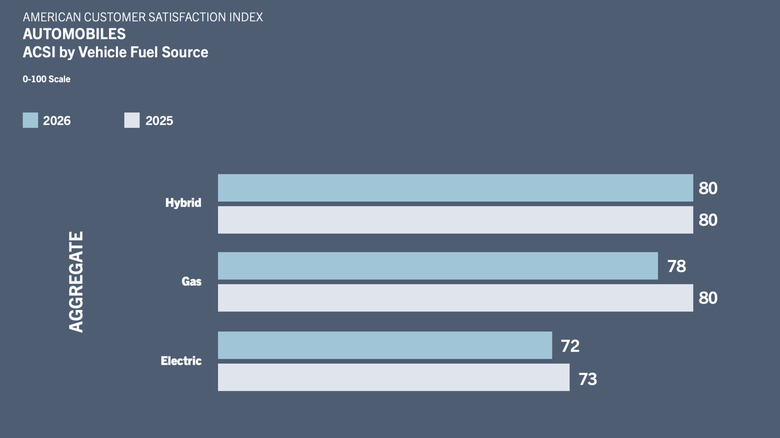
Hybrid vehicle owners report better satisfaction than pure-petrol and EV customers, both in the mass-market and luxury segments. However, the delta between the fuel sources isn't as significant in the luxury space as it is among mass-market vehicles. For example, mass-market EV owners have a satisfaction score of 69, which is a lot lower than the respective 78 and 80 across petrol-only and hybrid vehicle owners. On the other hand, the 76 that ASCI found among luxury EV owners is not that far off from what's seen within the segment. That said, loyalty across mass-market EV owners has improved dramatically year-on-year, with customer retention jumping from 57% to 71%, repurchase likelihood improving 13%, and likelihood to recommend improving 9%. According to ASCI, this is largely the result of owners investing in home charging and establishing reliable charging routines.
Comments
0 comments