
America's Last Production Straight-Eights Were Relics When They Bowed Out in 1954
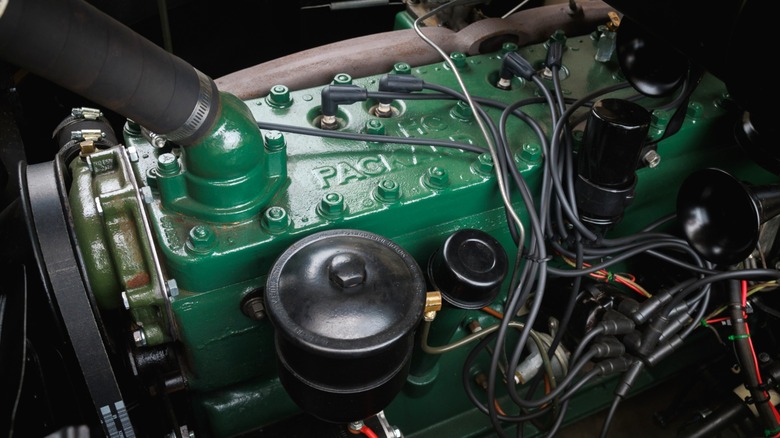
The last of the American inline-8 engines (or straight-8s) disappeared after the 1954 model year, by which point, they had already been rendered relics. Like the last two animals to march off Noah's Ark, the inline-8 disappeared as a pair, with both Pontiac and Packard – car brands we'd love to see return — being the last brands to feature this archaic configuration. Both brands had famously relied upon straight-8 power for decades by that point, so clearly it was somewhat long in the tooth once everyone had ditched it in the '50s. In Pontiac's corner sat the 268 cubic-inch inline-8, powering models like the Chieftain and Star Chief, while a vast array of Packard models took motivation from the automaker's 288, 327, and 359 cubic-inch mill. Come the 1955 model year, both firms retired these outdated eight-cylinders in favour of entirely new overhead-valve V8s.
Now, it's worth noting that the inline-8 configuration still had its merits, even at this late stage of the game, offering exceptional refinement and smooth operation thanks to the inherent balance of the inline-8. But the market was changing, and American cars were adapting to new buying behaviours. Consumers were favouring new body styles, which often no longer sported the elongated bonnets that could easily accommodate such long engines. Lower-slung bodies also required more compact engines, which also meant less mass hanging over the front wheels. A V8 delivered advantages in both departments, rendering the inline-eight instantly outdated. Furthermore, V engines were proving capable of handling higher compressions, and while the late inline-eights matched early V8s in terms of power, it was clear the V8 still had some way to go.
Replacing America's inline-8s
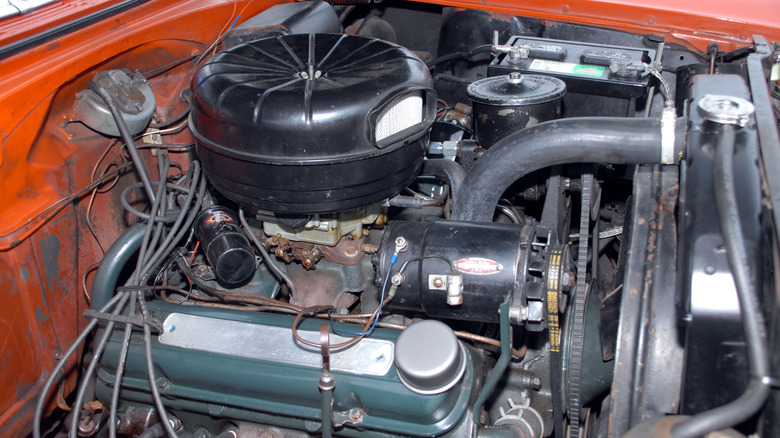
There was another factor at play, too. Not only were these inline-8 engines old, but so was the tooling required to make them. With both companies already facing the expense of replacing said ageing tooling, investing in a new overhead-valve V8 design instead made far more sense than trying to modernise an engine architecture the rest of the auto industry had already decided to walk away from. Those new V8 engines solved a multitude of problems for Packard and Pontiac. Firstly, they were far lighter and more compact, fitting more modern body designs. The V8s also benefited from shorter crankshafts, which would have reduced torsional stresses and helped make the engines more reliable without overengineering, as was the case with the inline engines.
Furthermore, the new overhead-valve designs allowed automakers to once again grow and develop with an exciting new platform. These engines introduced enhanced breathing capabilities, compact combustion chambers, and they gave automakers the opportunity to develop V8s with ever-higher outputs in the future. It was exciting technological advancements like these that really made America fall in love with the V8 and made the old inline-eights look ancient in comparison. But, just because inline-8s were cast aside and outdated, it didn't make them irrelevant overnight. They were still wonderfully smooth and capable engines, known for being packaged in some of the most elegant and desirable American classics ever produced, such as the Duesenberg SJ and Packard 343 Eight, and admiration for the mills continues in enthusiast circles.
Comments
0 comments