
Ferrari to reintroduce manual gearbox on top-end models
Automatic gearboxes and electrification are all the rage these days. The sports car market is no different. Even the Porsche GT3 is dominated by automatic versions.
As a result, it's hard to come across traditional sports cars with mechanical character.
Car manufacturers use automatic gearboxes because they offer more advantages than manual ones.
Firstly, shift times are faster. It takes a human at least 0.3 to 0.5 seconds or more to press the clutch and change gear, but gearboxes like Porsche's PDK or Ferrari's DCT can change gears in milliseconds (thousandths of a second). This virtually eliminates power interruption, improving acceleration (0-100 km/h) and track lap times.
Drivers only need to operate the paddle shifters behind the steering wheel, allowing them to focus solely on steering and braking even at high speeds. It also prevents accidental downshifts that could over-rev the engine or damage the gearbox. Additionally, manual supercars used heavy clutch pedals to handle immense torque, making city driving in traffic a chore. The fact that power transmission efficiency has now reached manual gearbox levels is another reason.
Consequently, supercars aimed at the wealthy are now launched with automatic gearboxes, making it easier to showcase performance and allowing drivers to handle the car with ease.
However, the ultra-wealthy want something more special. And there are rumours that Ferrari is preparing a gift for traditional car enthusiasts and collectors. It is said that Ferrari's latest grand tourer (GT) lineup's iconic model, the '12Cilindri', which features a naturally aspirated V12 engine, will be offered with a manual gearbox. This would mark the return of a manual gearbox paired with a V12 engine after 20 years.
The revival of the manual gearbox. When did Ferrari abandon manual gearboxes and adopt automated ones?
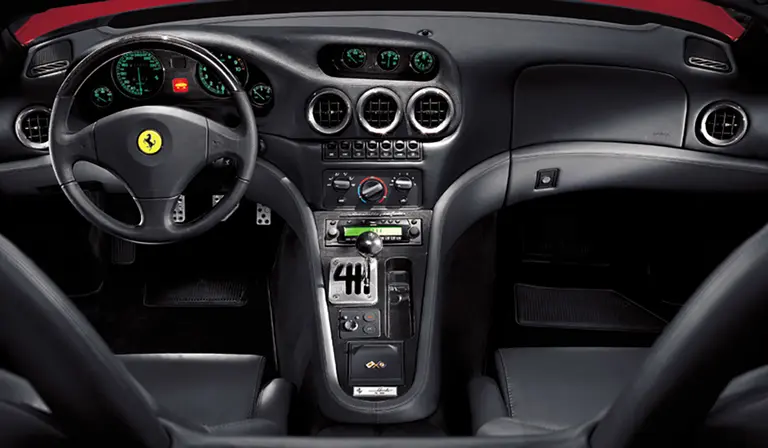
Ferrari's 'H-gate' manual gearbox was a brand icon. Then, in 1997, Ferrari launched the F355 F1 (Berlinetta) model, drawing a new future. The 'F1' in the model name signified an automatic gearbox. Ferrari introduced the electro-hydraulic semi-automatic gearbox, first seen in Formula One in 1989, to the production F355 in 1997, calling it the 'F1 gearbox'. Paddle shifters behind the steering wheel enabled rapid gear changes. Even BMW, more mainstream than Ferrari, first introduced an automatic gearbox, the SMG I, in its sports coupe M3 in 1997.
Ferrari's F1 gearbox offered incredible shift speed and convenience, and eventually, Ferrari owners moved away from manual gearboxes. Time passed, and the manual gearbox disappeared with the 2007 Ferrari 599 GTB Fiorano, the top-tier V12 model. By then, automatic gearboxes and paddle shifts were already commonplace, so only about 30 units of the 599 GTB with a 6-speed manual gearbox were produced.
However, collectors seeking rare manual gearboxes later emerged, creating demand for manual versions of the 599 GTB and 575M Maranello. Enthusiasts wanted the feel of the last analogue Ferraris. Consequently, these cars commanded huge premiums at auction.
The upcoming manual version of the 12Cilindri is expected to retain the existing 6.5-litre naturally aspirated V12 engine. Maximum output is around 830 bhp.
And it will be paired with a clutch pedal and traditional gear lever. This means the return of gear changes with that distinctive metallic 'clack' sound. It's not yet known whether the new gearbox will have six or seven gears, but the mere arrival of a manual gearbox has Ferrari enthusiasts excited.
However, owning a manual Ferrari may not be easy, even for the wealthy. This is because the manual 12Cilindri is expected to be produced in very limited numbers. As always, Ferrari plans to offer purchase rights only to its most loyal, top-tier VIP customers.
The manual gearbox is expected to be unveiled on 29th June. The prevailing view is that Ferrari will reveal the manual version to VIPs at its customer event, the 'Ferrari Cavalcade'.
Comments
0 comments