
RTI announces 'Connect Drive', a real-time data communication platform for SDV
RTI (Real-Time Innovations), a data streaming company for intelligent distributed systems, today announced its data-centric connectivity architecture strategy for the era of software-defined vehicles (SDVs) and its vehicle communication platform, 'Connext Drive®'.
Smart cars… real-time data communication is the key competitive advantage
The global automotive industry is undergoing a paradigm shift from a component-centric hardware architecture to a 'software-defined vehicle (SDV)' architecture, where software determines the functionality and value of the vehicle.
As advanced technologies such as autonomous driving (ADAS), in-vehicle artificial intelligence (AI), 'Zonal Architecture' which groups and integrates electrical and electronic equipment by zone, and real-time internet connectivity services (connected cars) are integrated into a single vehicle, a 'neural network' communication infrastructure has become essential. This infrastructure enables the numerous computers and control units inside the vehicle to exchange vast amounts of data safely, in real-time, and without delay.
To solve this problem, RTI provides a platform that utilises DDS (Data Distribution Service™), a data-centric communication standard technology. This technology automatically connects the data sender and receiver, even if they are unaware of each other's location. In particular, it is optimised for in-vehicle networks as it features Quality of Service (QoS) management functions that allow fine-grained control over transmission speed and priority based on the importance of the data.
The combination of DDS and TSN: Achieving ultra-precise vehicle communication with flawless timing
In this announcement, RTI introduced a 'deterministic communication' strategy that combines its software connectivity technology (DDS) with TSN (Time-Sensitive Networking), a next-generation vehicle network technology. This strategy ensures that data arrives reliably within a specified time on the in-vehicle network.
TSN is a hardware standard technology that clears a path for critical data on automotive Ethernet networks, ensuring it is transmitted within a defined timeframe without interruption. RTI has combined the flexible data exchange technology at the software level (DDS) with the time control technology at the hardware level (TSN) in a dual-layer approach.
Using this method ensures uninterrupted, safe communication even in mission-critical situations where a timing error of just a few milliseconds (ms, one-thousandth of a second) – such as in autonomous driving, remote vehicle operation, or real-time synchronisation between the vehicle and the cloud – could lead to a major incident. This is because it separates and controls the data flow, preventing general data traffic like audio or video from interfering with life-critical data flows, such as brake or steering control, even under heavy load.
Connext Drive: A safety solution validated by over 2 million vehicles on roads worldwide
RTI's vehicle communication platform, 'RTI Connext Drive', is currently installed in over 2 million vehicles on roads worldwide, having proven its performance. More than 25 global original equipment manufacturers (OEMs) have adopted it for software-defined vehicle development, and notably, over 50% of the top 10 global electric vehicle (EV) startups use this platform.
Connext Drive connects everything from the high-performance computer (HPC), which acts as the vehicle's brain, to the smart cockpit (digital instrument cluster) and peripheral device control. It has passed safety and cybersecurity standards for the automotive sector, certified by the global certification body TÜV SÜD.
The key advantages of Connext Drive are as follows:
Bridging legacy and modern architectures: It facilitates a smooth transition from legacy systems used in existing vehicles to a modern SDV architecture without the need for complex custom code modifications.
Ensuring consistency from simulation to production: Software code used for testing on virtual computers (simulation) can be reused without modification all the way through to the production phase of building actual vehicles, significantly reducing development time and costs.
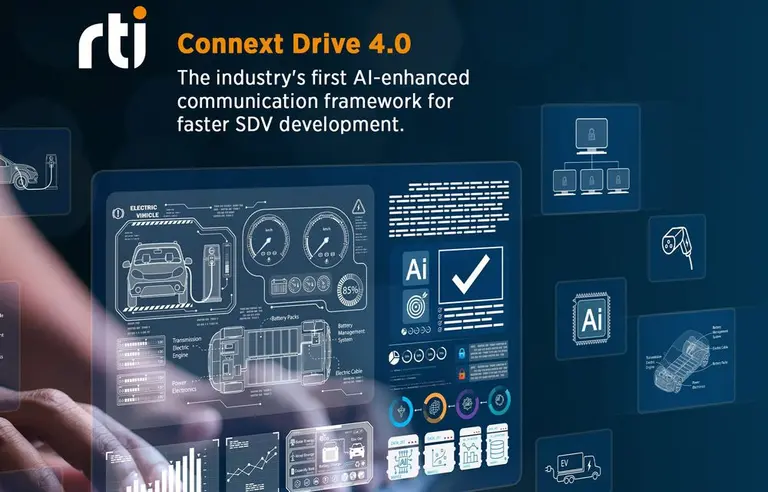
AI-powered advanced development tools (Connext Drive 4.0): It features industry-first AI-based development automation, test automation, and operational monitoring capabilities, along with a standard toolchain. This boosts productivity, enabling globally distributed development teams to collaborate quickly and efficiently, even remotely.
Supporting full vehicle domain integration: It covers communication across all domains required for software-defined vehicles, including zonal control, high-performance computing (HPC), vehicle-to-cloud connectivity, and simulation environments.
Full compatibility with global standards: It is directly integrated or fully compatible with AUTOSAR (Classic and Adaptive), the open automotive software standard, and ROS 2 (Robot Operating System), maximising development convenience.
Global application case: Expanding global market presence, including adoption across all XPENG models in China
RTI Connext Drive has already proven its technological capability by being applied to over 250 autonomous driving programmes worldwide. Notably, XPENG, a leading smart electric vehicle company in China, has adopted Connext Drive as the core communication technology for all its vehicle models scheduled for launch in 2026, in order to implement its next-generation electrical and electronic vehicle architecture. XPENG evaluated Connext Drive as a platform with high reliability and flexibility already proven in production environments, and well-suited for implementing an integrated vehicle architecture.
RTI emphasised that Connext Drive's 'data-centric architecture' can solve the common challenges many automakers face when transitioning to software-defined vehicles, including: ▲ ensuring interoperability between platforms like Android, Linux, QNX, and AUTOSAR; ▲ implementing high-performance, real-time data communication; ▲ reusing code across development stages; and ▲ simultaneously ensuring functional safety and cybersecurity.

Comments
0 comments