
How Tadek Marek’s Aluminium Inline-Six Made the Aston Martin DB4, DB5, and DB6
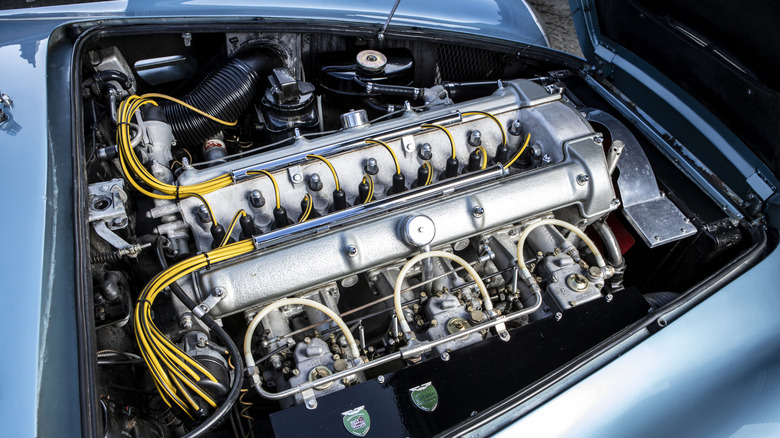
Tadek Marek was a Polish engineer who, despite nearly missing out on the job at Aston Martin due to a rejection letter being sent out by mistake, deserves much of the credit for the creation of Aston Martin's legendary DB cars. The all-new inline-six engine he worked on in the mid-1950s helped turn these cars into icons and was a huge improvement — in terms of both performance and reliability — over the engine that came before it. The Tadek Marek aluminium inline-six went on to power the DB4, DB5, and DB6, plus the DBS, with a production run that continued well into the 1970s.
Marek's journey with the storied British carmaker begins in the 1950s. Marek wasn't initially hired to start work on an exciting new engine, but rather to extract every last drop of usefulness from the DB2's Bentley-designed W.O. engine that he could for the new DB Mark III. The inline-six had been doing the rounds at Aston Martin for some time by this point, but it was plagued by various reliability issues, which Marek solved while introducing a welcome dose of extra horsepower for the then-new Mark III. But by this point, Aston had relied on the W.O. Bentley inline-six for as long as it possibly could. The firm needed a new engine to enter the swinging sixties, and Marek was the man for the job.
Marek's inline-six was a new engine for a new era
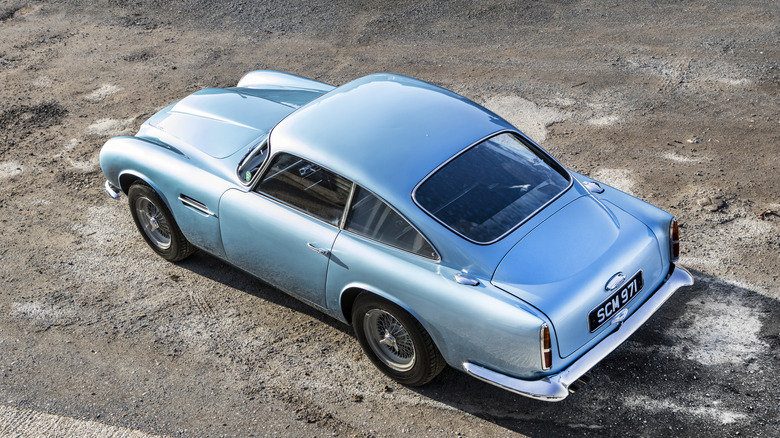
Work on the new engine, designed for the then-new DB4, began in 1955. It was an all-aluminium dual overhead cam inline-six, with a compression ratio of 8.25:1. It initially boasted a 3.7-litre displacement and packed 240 horsepower, with fuel delivered via a pair of SU HD8 carburettors — a clear step up in comparison to the 162 horses available in the old DB Mark III. Early iterations of Marek's inline-six were not without issues, though. This was the first engine he'd designed from aluminium, and as a consequence of his inexperience, clearances could expand when the engines were run over long distances continuously, causing low oil pressure. This wasn't the only issue either — early cars would also overheat, which resulted in bearing failures.
Marek and Aston Martin worked to overcome these issues as the cars and the engine developed. The sump was modified to allow for a larger oil capacity, and an oil cooler was fitted for Series 2 cars onwards. During 1961, and the DB4's fourth series, a Vantage model was made available. It sported a uniquely styled bonnet scoop, a reworked inlet manifold with a new boxed-plenum chamber, bigger valves, a higher 9:1 compression ratio, and an extra carburettor, which saw output climb by a further 26 horses. The ultimate iteration of the 3.7-litre engine came with the DB4 GT, which sported two spark plugs per cylinder, a trio of Weber carburettors this time, high-lift cams, and an output that climbed past 300 hp, in addition to 270 lb-ft of torque.
How Marek's inline-six evolved in the DB5 and DB6
The Aston Martin DB5 debuted in 1963, and while it visually shared much in common with the latter run of DB4s, things had certainly changed under the bonnet. Marek's inline-six had seen its displacement increased from 3.7 to 4.0 litres, with output climbing to 282 horsepower, alongside 288 lb-ft of torque. It wasn't long before a Vantage model was also introduced to the DB5 range, which saw output soar to 325 horsepower — once again courtesy of some hot cams and more meaningful carburettors. In this guise, Marek's "six" was capable of propelling the DB5 Vantage to speeds north of 150 mph, and to 60 mph in just 6.5 seconds.
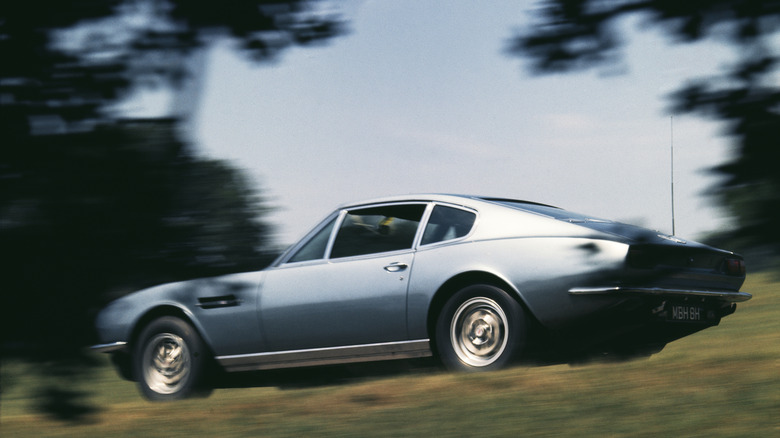
Marek's mechanicals remained unchanged in the DB6 that came next, although buyers of later cars had the choice to swap the carbs for a fuel-injection system — not that it proved to be a popular option at all. The Aston Martin DB6's production ended after 1970, although this wouldn't be the end of Marek's engineering influence. His inline-six continued on in the DBS, which debuted in 1967 and ran alongside the DB6 for a while. It was originally designed to take motivation from an all-new V8 engine – another impressive Marek design that would motivate Aston models for many decades — but the V8 wasn't ready in time. It eventually arrived in 1969, and both the six- and eight-cylinder DBSs sold alongside one another, until the model was discontinued in 1972.
Comments
0 comments