
Chaevi secures simultaneous orders for public rapid EV charger projects from the Ministry of Climate and Seoul Energy Corporation
South Korean electric vehicle rapid charging infrastructure operator CHAEVI (CEO Choi Young-hoon, formerly Daeyoung CHAEVI) has simultaneously won contracts for public electric vehicle rapid charger projects commissioned by the Korea Environment Corporation, under the Ministry of Climate, Energy and Environment, and the Seoul Energy Corporation. Having been selected as the operator in this year's tenders following technical evaluations and verification of project execution capabilities, the company has demonstrated its competitiveness in the domestic public rapid charging market.
First, CHAEVI has been selected as the operator for Zone 4 in the '2026 Public Electric Vehicle Rapid Charger Manufacturing and Procurement Project'. This project involves installing public rapid chargers of 100kW or more at key locations nationwide, in line with the government's policy to expand electric vehicle charging infrastructure. CHAEVI has been assigned Zone 4, encompassing Busan, Daegu, Ulsan, South Gyeongsang, and North Gyeongsang. Through this project, 136 standalone 100kW chargers and 113 simultaneous 200kW chargers will be installed along major transport routes across the country.
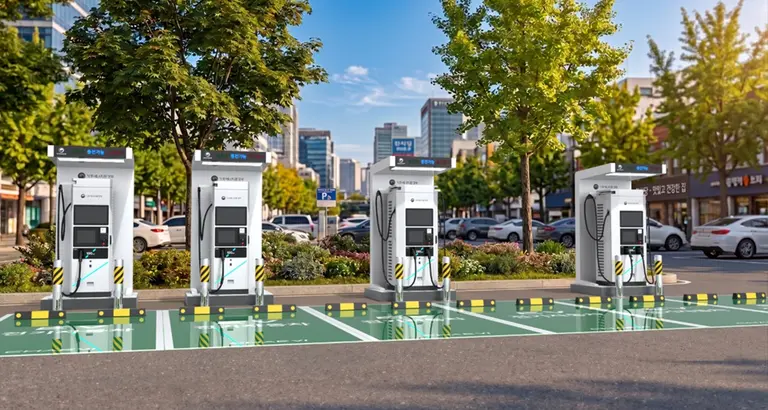
In addition, CHAEVI has also won the '2026 Seoul Metropolitan Government Public Electric Vehicle Charging Facility Equipment Manufacturing and Procurement Project'. Accordingly, by December this year, the company plans to install 12 dual rapid chargers (100kW and 200kW) and 8 canopies at public facilities in Seoul. Through these two projects, CHAEVI will manufacture, supply, and install approximately 260 public rapid chargers in the 100–200kW range, contributing to the expansion of public charging infrastructure.
The Ministry of Climate project has attracted attention not only for the scale of the contract but also for its evaluation method. This year's tender allocated 90 points out of 100 to technical capability and 10 points to bid price, meaning that technical excellence, rather than price, served as the key criterion for selecting the operator. In particular, a strengthened technical verification system was introduced compared to the previous year, including reflecting the localisation of key charger components as a quantitative evaluation item and increasing the weighting of proprietary technology assessment.
Furthermore, a new 'Charger Performance Improvement' category was introduced this year, requiring bidders to provide certified test reports from accredited institutions proving power conversion efficiency of at least 95%, connector insertion and extraction durability of over 20,000 cycles, and OCPP 1.6 or higher software security certification. These stringent criteria demanded compliance in charging efficiency, mechanical durability, and cybersecurity. CHAEVI passed all three requirements based on its research and development capabilities, which incorporate field operation data into product design.
The 'Supply Chain Stabilisation' category, introduced for the first time this year to address global supply chain instability, also highlighted CHAEVI's strengths. This category assessed the domestic procurement ratio of key components—such as power modules, PLC modems, LCDs, and connectors—and the level of supplier diversification. CHAEVI's competitiveness was recognised thanks to its domestic supply chain for major components and its multi-supplier system. The company's proactive strategy to diversify its supply chain, aimed at reducing dependence on specific countries or companies, has yielded results.
The new technology evaluation criteria were also more detailed than in previous years. Specific standards were strengthened for Plug and Charge (PnC), integration with electric vehicle manufacturers, fire prevention technology, user convenience, and accessibility features for the mobility-impaired. CHAEVI demonstrated its technical completeness based on its in-house design and manufacturing capabilities, its track record of compatibility testing with domestic automakers, and its patents in the charger field.
CHAEVI's operational competitiveness also stood out in the after-sales management category. The tender applied quantitative evaluation criteria that favoured companies achieving a failure rate of less than 1% and an average repair time of within three days. CHAEVI proved its management capabilities based on its track record of operating public rapid chargers nationwide. As a company that both manufactures and operates chargers, its ability to quickly incorporate field data into after-sales service and product improvements is also regarded as a competitive advantage.
As the government pushes ahead with expanding public charging infrastructure, aiming to deploy over 1.23 million electric vehicle chargers—including 145,000 rapid chargers—by 2030, CHAEVI's success in these tenders means it will supply chargers to both the Ministry of Climate and the Seoul Metropolitan Government. With the growing importance of stable rapid charging infrastructure operation and user convenience alongside the expansion of electric vehicle adoption, CHAEVI is expanding its projects with government and public institutions, leveraging its strength in translating field operational experience into product competitiveness.
Meanwhile, CHAEVI has recently been awarded the Ministry of Environment's rapid charging facility on-site inspection and maintenance outsourcing contract for the fourth consecutive year, and has also been selected for the mobile electric vehicle charging service outsourcing operation project, thereby expanding its capabilities across the entire spectrum of public charging infrastructure construction, operation, and maintenance.
Comments
0 comments