
[Comparison Test] 4 Budget Sports Tyres… Which is the Best?
In the domestic market, where the four seasons are distinct, the most widely used tyres are all-season tyres. Expectations in the market are high regarding ride comfort and quietness.
In contrast, Japan, which has a similar climate, has a different situation. From spring to autumn, they use summer tyres, and when winter comes, they switch to winter tyres. They then store the spare tyres at home, or at places like Autobacs or a tyre shop. The Korean market is different. Visiting a tyre shop twice a year to pay for fitting and removal, as well as storage fees, is a burden. Only in the Gangwon-do region, which is a snowy area, is the fitting rate for winter tyres high.
Another misconception is thinking that 'summer tyres = high-performance sports tyres'. Just as many consumers say, 'I don't drive on circuits' when discussing stability for vehicle safety, this is an area where surprisingly strong perceptions are entrenched.
However, summer tyres are also broadly divided into two categories: those for sporty driving, and those aiming for the ultimate comfort.
Leading representatives of top-tier sports tyres include the Michelin Pilot Sport 4 S (PS 4S), Continental SportContact 7 (SC7), and Bridgestone Potenza Sport.
On the other hand, in the world of comfort-oriented summer tyres, the Michelin Primacy series, Continental PremiumContact series, and Bridgestone Turanza T005 are well-known.
Summer Tyres
Top-Tier Sports Tyres
Michelin Pilot Sport 4 S, Continental SportContact 7, Bridgestone Potenza Sport, Kumho Ecsta Sports S, Hankook Ventus S1 evo Z
Top-Tier Comfort Tyres
Michelin Primacy 4, 5, Continental PremiumContact series, Bridgestone Turanza T005, Turanza 6
Although they are all summer tyres, their focus differs. Sports-type summer tyres prioritise braking performance, cornering, handling, and wet-road performance, based on the highest grip levels.
In contrast, premium comfort summer tyres focus on quietness and ride comfort, built upon adequate performance. They also offer long life and good rolling resistance, which is beneficial for fuel economy.
What is clear is that the popularity of summer tyres in our tyre market is very low.
Given this situation, only some consumers driving high-performance cars use premium-grade sports tyres. One reason is the high price of the tyres themselves.
Despite the sports summer tyre market having such limited commercial appeal, some tyres sell surprisingly well. These are sports tyres that pursue cost-effectiveness.
Sports tyres are divided into three types: tyres that prioritise economy (price) with slightly lower performance, tyres that deliver the highest performance, and tyres that offer performance close to the top tier at a relatively reduced price.
Until just a few years ago, only economy tyres and top-tier tyres were sold. Leading representatives of economy tyres were the Bridgestone Potenza RE001~RE004, Michelin Pilot Sport 3, Kumho Ecsta PS91, and Hankook Ventus V12 EVO2.
However, Michelin significantly raised the bar with the introduction of the Pilot Sport 5, giving it performance comparable to the top tier. In response, Continental launched the MaxContact MC6.
Now, all tyre manufacturers have discontinued economy tyres and are making tyres in the same class as the Michelin PS5.
So, the current situation is as follows:
Top-Tier Tyres: Michelin Pilot Sport 4 S, Continental SportContact 7, Bridgestone Potenza Sport, Hankook S1 EVO Z, Kumho Ecsta Sport S (PS72), Pirelli P ZERO, Goodyear Asymmetric 6, etc.
Upper-Mid-Range Tyres: Michelin Pilot Sport 5, Continental MaxContact MC7, Hankook Ventus evo, Kumho Ecsta Sport (PS71), etc.
This is based on our tests conducted in 2025. (More upper-mid-range tyres are expected for 2026.)
We plan to re-evaluate more tyres soon, but for now, let's look at the comparison results of four upper-mid-range tyres tested based on 2025 standards.
Focusing on dry road performance according to tyre characteristics, we added circuit driving performance to verify the actual performance and balance of each tyre.
Basic Test Environment
Test Car
Hyundai Avante N Line (CN7)
Tyre Size
235 / 40 R18
Tuning Details
- Suspension (German Eibach lowering springs), - Brakes: Hyundai Veloster N front calipers, Sonata N Line discs, Kona N brake pads * Light tuning focusing on braking power and braking consistency.
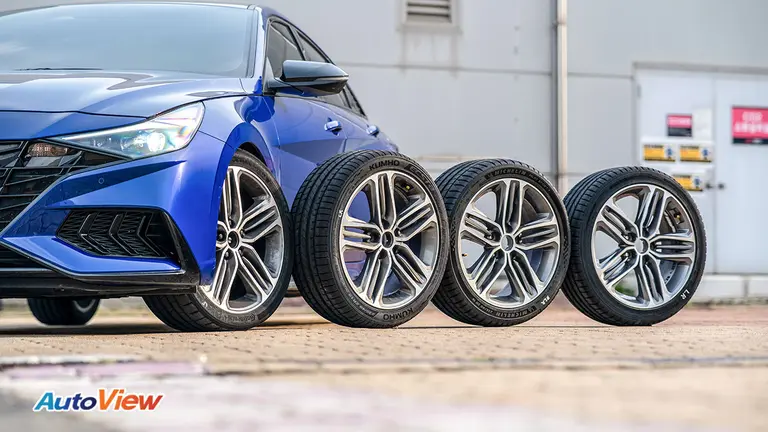
Tyres Compared
Michelin Pilot Sport 5 (hereafter PS5): Balanced performance with high consumer satisfaction. Serves as the benchmark tyre in this test.
Continental MaxContact MC7 (hereafter MC7): Currently recording the best scores in its class.
Hankook Ventus evo (hereafter evo): Occupies the mid-range in Hankook's sports tyre lineup. (Note: top-tier S1 evo Z, lower-tier V12 EVO2)
Kumho Ecsta Sport PS72 (hereafter PS72): The successor to the PS71, which received mixed reviews compared to its competitor (V12 EVO2). The key question is whether performance has improved.
Now, let's look at the performance in detail.
Dry Road | Braking Performance (100-0 km/h)
The distance required to come to a complete stop from 100 km/h was measured.
The maximum error range of the measurement equipment is less than ±1.8 cm. The recorded result is the average distance after excluding the longest and shortest distances.
The tyre showing the most outstanding performance was the Continental MC7. It transferred the force of the calipers gripping the disc firmly to the road surface. It was effectively the only tyre to record a braking distance under 34 metres, demonstrating the best braking performance. The MC7 also yielded the best results in terms of braking feel when operating the brake pedal.
Next was the Michelin PS5, which was about 60 cm behind the MC7 but still perfectly capable of enhancing the braking power of the Avante N Line.
The Hankook evo also recorded a level of 34.7 metres, not significantly different from the PS5. The Kumho PS72 performed reasonably well, but the gap in performance compared to its competitors was significant.
Dry Road | Cornering Performance (Based on 40R)
Cornering limit performance was assessed by measuring the average speed a tyre could maintain before sliding during circular driving.
To account for potential surface variations, the measurement section was set to about a quarter of the full circular course.
Numerically, the Kumho PS72 recorded the highest lateral grip limit at 73.7 km/h. This is a performance advantage of nearly 3 km/h over the lowest-ranked Hankook Ventus evo.
However, its behaviour becomes abrupt once the limit is exceeded. While grip is high, it doesn't give the driver enough time to react at the limit. It was like a double-edged sword: high limits but disappointing behaviour characteristics.
In contrast, the MC7 and PS5 exhibit linear movement even when approaching or exceeding the limit. This makes it easier for the driver to understand the tyre's grip and control the car. Even when sliding beyond the grip limit, the car's behaviour increases progressively, making it highly predictable. The tyre industry places greater value on these characteristics.
Dry Road | Circuit Lap Time
This is the most demanding test. Temperature variations and the car's condition can affect lap times. Most importantly, the test car, the Avante N Line, has average cooling system performance, showing differences in consistency compared to full sports models.
Therefore, we deliberated extensively on whether to include this item in the official records. However, testing on a circuit combines complex factors like braking consistency, the balance of lateral grip and acceleration, and handling, producing a comprehensive result.
Furthermore, these characteristics are among the aspects highly valued in subjective evaluations.
In other words, while the lap time itself may be for reference, it is meaningful for confirming the balance in a complex environment.
Dry Road | Handling Performance
Michelin PS5: A clear advantage is the predictability when turning the steering wheel. The consistent, weighty feel of the steering wheel, regardless of speed, is also a characteristic. Overall grip levels are adequate, and the limit is communicated clearly, allowing the driver to easily gauge the threshold. The stable behaviour characteristics are excellent.
Hankook evo: Initially, the steering wheel feels heavier than the Michelin PS5, but it would be better if it didn't become lighter as speed increases. Steering response is slightly slower than the PS5 during initial fine steering inputs and the first phase of preparing for a corner. While generally adequate, the tendency for behaviour to break down abruptly at a certain point is a slight disappointment. However, the grip feel communicated to the driver within the grip range is good.
Kumho PS72: Grip itself is adequate, but the steering feel is somewhat vague. Particularly at high speeds, predicting the car's behaviour is less satisfying compared to its competitors. As felt during the circular driving test, yaw characteristics change rapidly when the limit of grip is exceeded. While grip is good, it leaves room for improvement in the handling department. Satisfaction would increase if the amplitude of vertical movement during very high-speed driving were better controlled.
Continental MC7: Overall, it shows the best steering performance. A wealth of information is transmitted through the tyre, and the consistently weighty steering feel adds to the confidence.
Lateral grip is adequate, but the overall tread stiffness and the lack of anxiety even when exceeding the limit are notable. Particularly, the consistent and precise development of yaw characteristics when the car is rotated is excellent. It offers the most reliable level of stability in environments like continuous cornering or a circuit.
Dry Road | Rolling Resistance
Rolling resistance is a hot topic in the tyre industry recently, due to various regulations and the need for greater driving range with the advent of electric vehicles.
However, reducing resistance with the road surface can, simply put, lead to reduced grip. It's difficult to reconcile these two areas, much like ride comfort and cornering performance.
In this test, the gearbox is put into neutral for a coasting test, and points are awarded to the tyre that travels the furthest.
The Michelin PS5 rolled the furthest distance. It not only had good basic performance but also managed rolling resistance well. This makes one curious about the performance of the 'PS5 Energy' (launching in 2026), which claims even lower rolling resistance.
Next was the Hankook evo, showing good capability on par with the Michelin. In contrast, the Continental MC7 and Kumho PS72 showed relatively higher resistance.
To put it positively, this is because of their good grip, but realistically, it seems they have missed part of the current trend.
Dry Road | Quietness
This might not be crucial for sports tyres. However, we don't enjoy sporty driving every day. Lower noise in daily driving makes for a more relaxing drive.
The Kumho PS72 was surprisingly quiet. There were no particularly irritating noise frequency ranges. This helps reduce driver fatigue on long journeys.
The Michelin PS5 and Continental MC7 showed similar average noise levels on the same road surface. There were subtle differences in the tone on rough roads, but not enough to give one an advantage over the other.
They generated slightly higher noise than the PS72, but the difference was hardly significant to the human ear.
The Hankook evo is also not bad. However, it gives the impression of being slightly noisier compared to the other tyres. Given its rolling resistance test score, I expected it to be near the top in quietness, so this was a surprising result.
Wet Road | Braking Performance (80-0 km/h)
Let's check the wet road braking performance, considering emergency braking situations in the rain. The test is based on a complete stop from 80 km/h.
The European market places great emphasis on wet road performance in summer, partly due to the high accident rate on wet roads. In contrast, awareness of wet road safety is still lacking in the domestic market.
Furthermore, from the standpoint of comparing and evaluating tyres, I would like to point out the inadequacy of domestic test facilities. Renowned overseas test facilities have wet handling courses for testing cornering on wet roads. In contrast, the state-run Korea Automobile Testing & Research Institute (KATRI) has no wet handling test track. Even the wet circular track at the BMW Driving Centre is not properly operational. Unless a Minister of Land, Infrastructure and Transport with an understanding of vehicle testing is appointed, the poor state of Korean test facilities will likely continue.
In any case, the only test currently possible is the braking test. However, we are researching a test method to determine the point at which aquaplaning occurs on wet roads, which may be introduced in the future.
The wet braking test results proved the Continental MC7 to be a force to be reckoned with on wet roads, recording an average distance of 23.65 metres.
The Michelin PS5 also performed well, with a gap of only 11 cm to the MC7. It unfortunately lost points because the 2025 evaluation criteria considered a difference of less than 10 cm as equal performance. However, the tyre industry considers them to be of equivalent performance.
Third place was the Kumho PS72, with an average record of 24.07 metres, which is a decent level. The Hankook evo recorded 24.45 metres, which is also not bad.
In conclusion, as products aimed at the European market where summer tyre demand is high, their wet braking performance was so close that it was difficult to determine a clear winner.
Product Price
In the upper-mid-range tyre market, price appropriateness is as important as performance. Consumers who don't consider price in the first place tend to go for top-tier (premium) tyres.
The Kumho PS72 offered the best price competitiveness. Based on the 235/40 R18 size, it was in the mid-100,000 won range.
Next was the Hankook evo, which was about 30,000 won more expensive than the Kumho. The Continental MC7, with the best performance, was about 50,000 won more expensive per tyre than the Kumho. The Michelin PS5, with its premium image, had to lose points due to being over 100,000 won more expensive than the Kumho.
Thus, the true value-for-money tyre is the Kumho PS72.
New Criteria for 2026
As mentioned earlier, this test was conducted last year. At that time, we used somewhat strict evaluation criteria. For example, a 10 cm difference in braking distance or an average 0.2 km/h difference in circular performance could determine superiority.
However, the evaluation criteria have changed for 2026. The new system is based on the top performer's record, with points deducted more heavily as the performance deviation increases.
Instead, the range considered 'equivalent' has been widened. For example, a braking distance difference within 50 cm is now considered equivalent. This is intended to be more tolerant of variables caused by surface deviations.
To help develop this method, we sought advice from researchers at various tyre manufacturers. While we couldn't satisfy everyone, we received opinions that it was, in principle, acceptable.
We also received requests to expand the evaluation area for the handling aspect. A final decision on this will be made as we conduct internal tests running until July. (It will be reflected in comparisons from September onwards.)
Applying the 2026 criteria yields the following results. In the 2025 evaluation, the Michelin PS5 held onto second place, but under the new system, it loses points due to its price disadvantage, ceding second place to the Kumho PS72.
Comments
0 comments