
Hyundai Next-Gen i20 N Revived as Hybrid... Will It Be Sold in Korea?
Hyundai's high-performance brand N has devised a new strategy to overcome environmental regulatory barriers in the European market. While the Korean market focuses on the Avante N (export name Elantra N) as its flagship model, catering to consumer preferences for larger cars, in Europe—traditionally known as the home of hatchbacks—the smaller i30 N and i20 N have garnered support from enthusiasts.
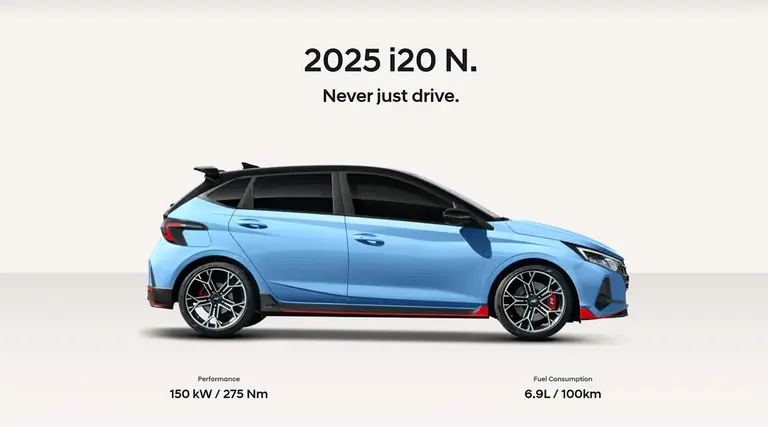
However, citing pressure from strengthened carbon emission regulations such as Euro 7, Hyundai announced in early 2024 the discontinuation of production and sales of the i20 N, which was equipped with a 1.6-liter pure internal combustion engine, in Europe. Another reason was that the company had been focusing on electrification (EV) development, putting internal combustion engine development on hold. Recently, in Australia and other markets, Hyundai released a limited edition of 100 units of the 'i20 N Shadow Edition' based on the final production batch of the current model, effectively signaling the end of the era for internal combustion engine hot hatches.
However, just a few days later, Manfred Harrer, President and Head of Hyundai's R&D, revealed in an interview with a British specialist magazine that "the revival of the i20 N in the European market is essential," and unexpectedly disclosed the development of a next-generation hybrid model.
President Harrer, who previously worked at Porsche and BMW, is known as an expert in chassis and vehicle dynamics. This has led to expectations that he will address not only the high-performance N brand but also the chassis performance shortcomings and straight-line stability issues caused by the steering system in Hyundai's mainstream models. Above all, he is expected to enhance the capabilities of the existing R&D department responsible for ride and handling (R&H).
He stated, "Currently, there is a perception among the media and fans that Hyundai N is solely focused on the world of electric vehicles (EVs)," drawing a clear line that Hyundai will not be exclusively biased toward EVs. President Harrer noted that the price and segment gap between the Ioniq 5 N or Ioniq 6 N and the existing internal combustion engine entry-level lineup (i20 N and i30 N) is too large, emphasizing the need to bring back an entry-level high-performance car with a lower barrier to entry and greater accessibility for N fans. He added, "To achieve this, we have completed a prototype vehicle and are conducting intensive testing out of sight."
The key change in the next-generation i20 N lies in the electrification of its powertrain. President Harrer stated that to reduce emissions while maintaining N's signature explosive driving fun, the company will apply a self-developed full hybrid (HEV) system, rather than a simple mild hybrid (MHEV). Foreign media predict that this will be based on the 1.6-liter 4-cylinder turbo hybrid engine used in models like the Tucson and Santa Fe, paired with a newly developed performance-oriented 'twin-motor hybrid transmission.' This system combines a P1 motor, which assists starting and adds torque to the engine, with a P2 motor, which directly drives the wheels and recovers braking energy, delivering a powertrain with up to 300 horsepower (224 kW) and 38.7 kgf·m (380 Nm) of torque.
This significantly surpasses the performance of the existing pure internal combustion engine i20 N (204 horsepower) and even exceeds that of the higher-tier i30 N. President Harrer emphasized that the goal is to take the new hybrid N to the Nürburgring circuit and achieve a lap time far superior to the current model. He stressed that the battery management system (BMS) and cooling performance are being meticulously refined to withstand the harsh driving conditions and heat on the track, and that the system will be tuned to deliver the characteristic crisp, punchy shifting feel and sporty emotion of a manual transmission, even in a hybrid setup.
Previously, the i20 N competed fiercely with models like the Volkswagen Polo GTI and Ford Fiesta ST. However, the newly revived i20 N hybrid is expected to attract attention in the European B-segment high-performance hot hatch market by combining 'affordability and high performance.'
However, its sales prospects in the Korean market remain uncertain. This is because the market prefers larger cars, and when high performance is combined with a resulting price increase, the potential customer base shrinks.
Comments
0 comments