
Smart Driving Goes Global: Just Get Out There First?
According to data from the China Association of Automobile Manufacturers, from January to May this year, China's cumulative automobile exports reached 4.059 million units, a year-on-year increase of 63%. Focusing on new energy passenger vehicles, during the same period, exports from January to May reached 1.792 million units, a year-on-year increase of 1.2 times. In the full year of 2025, China's automobile exports had already surpassed the 7 million mark, reaching 7.098 million units. China has maintained its position as the world's largest automobile exporter for three consecutive years.
Alongside the growth in export scale, the penetration rate of China's intelligent driving technology is also rising. According to data from the automotive industry big data platform, in 2025, the penetration rate of new passenger cars equipped with standard L2+ and above functions in China had reached 28%; by April 2026, this figure had exceeded 41%.
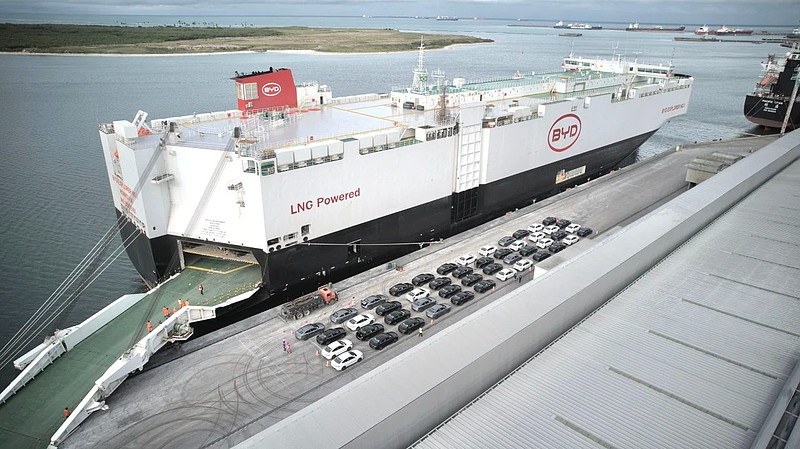
As "Chinese cars" become a common sight on roads worldwide, can "Chinese intelligent driving" keep pace? With L2+ rapidly gaining popularity in China, has intelligent driving going global become a new incremental trend? The answer seems to be yes. But the question lies in: how to go global? At what pace? Sell the cars first and add features later, or go all-in with complete capabilities from the start?
The First Hard Barrier for Intelligent Driving Going Global
TomTom Greater China Senior Customer Success Manager Chen Weicheng made a statement at the 9th Intelligent Driving and Going Global Conference that pinpointed the industry's awkward position: "When Chinese intelligent driving goes overseas, the first wall it hits is compliance." It's not that the technology isn't good enough; it's that the rules don't allow it.
The compliance system in the EU market is a layered "pyramid." The bottom layer is the framework established by the United Nations Economic Commission for Europe (UNECE), covering over 60 countries including the EU, South Korea, Australia, and Japan. On top of this, the EU imposes stricter GSR (General Safety Regulation) requirements. Further up are the national legislations of individual member states.
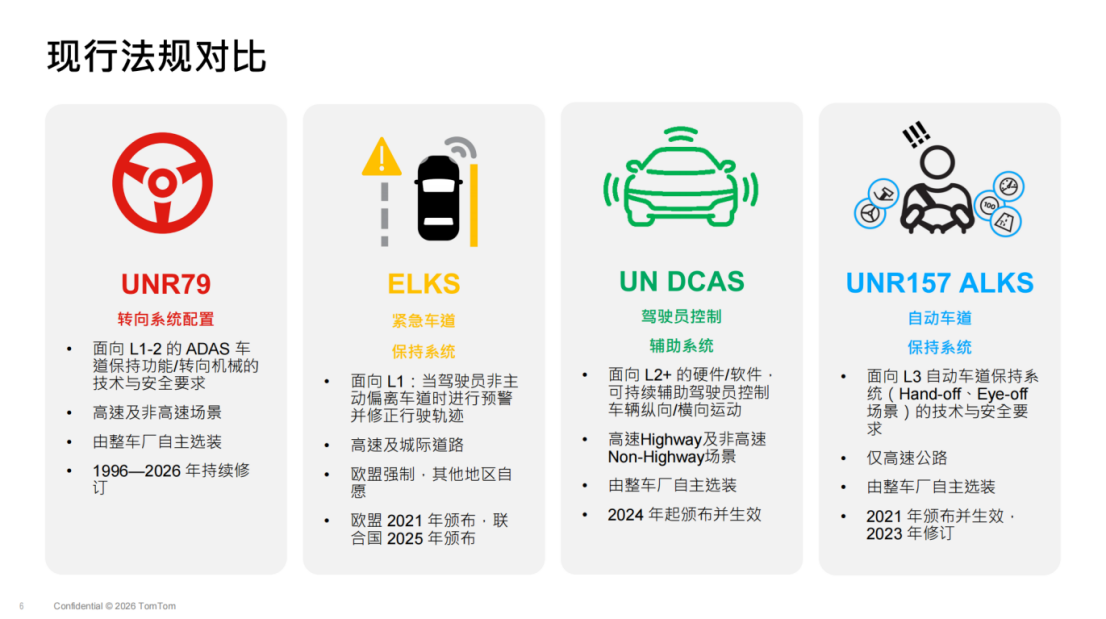
Specifically at the technical level, four key regulations form the entry barriers for the European market: UN R79 (Steering Equipment, covering L1/L2 lane keeping), ELKS (Emergency Lane Keeping, mandatory in the EU since 2021), UN DCAS (Driver Control Assistance Systems, targeting L2+ scenarios, directly related to NOA functions mass-produced by Chinese automakers), and UN R157 (Automated Lane Keeping Systems, L3 level, the real ticket for "Hands-off, Eyes-off" on highways).
Zhang Wei, Senior System Director at知行科技 (Zhi Xing Technology), shared practical insights: "In the EU, there's R79 for lateral functions, R152 for AEB, and R48 for headlights. The most challenging, requiring the most real-world validation, is the Intelligent Speed Assistance (ISA) requirement under the EU GSR framework, corresponding to UNECE R152 and related technical regulations." ISA requires vehicles to accurately identify speed limit signs from different regions and respond accordingly. This sounds simple, but achieving high accuracy within Europe's multilingual traffic sign system requires massive amounts of real-world road testing – which then hits another wall: data compliance.
Regulations are also evolving rapidly. Over the next three to five years, L4-level autonomous driving regulations are accelerating. The EU's Artificial Intelligence Act has incorporated AI into the automotive safety framework – meaning the algorithm itself will be subject to regulation in the future, not just the final outcome. From 2021 to 2030, key regulatory milestones are taking effect almost every year.
Huang Luoyi, Director of Intelligent Driving Toolchain and Infrastructure for Bosch's Intelligent Driving and Control China region, illustrated the complexity of regulations with a personal experience. He saw a traffic sign near Frankfurt Airport but failed to recognize it twice, nearly causing an accident. "Functional regulations are not as simple as people think," he said. If an experienced driver of over a decade can misidentify a sign, what about an algorithm?
Compliance is an unavoidable wall. For Chinese automakers, the question isn't "can we climb over it," but "how do we climb over it, and at what cost?"
Localized Training is a "Non-Negotiable Bottom Line"
If compliance is a "visible wall," then data is an "invisible abyss."
Huang Ziliang, Intelligent Driving Solutions Expert at Huawei Technologies, pointed out the essence of the data problem during a panel discussion: "Data used for training intelligent driving large models definitely cannot leave the country where the vehicle is sold. In the future, for Japan, traffic data on Japanese roads must be trained in Japan; for Europe, it must be trained in Europe." This is not a technical choice but a legal red line.
GDPR (General Data Protection Regulation) is the most typical example. Huang Luoyi explained that GDPR clearly stipulates: general violations are fined up to 10 million euros or 2% of the company's global annual turnover (whichever is higher); serious violations are fined up to 20 million euros or 4% of global annual turnover. "It might not matter much for small companies, but for Bosch, we can't afford to lose."
An even greater challenge comes from the "opt-in" rule for data privacy – some countries require obtaining consent from the data subject before collecting or processing personal privacy data. Huang Luoyi retorted: "If I go out to collect data, how do I get consent from pedestrians and car owners on the street? I can't do it."
This directly leads to a common phenomenon. Chen Yichi, CTO of KPIT China, disclosed a key observation during a panel discussion: "Last year, we received many projects for overseas data collection, which involved desensitization and compliance processing before bringing the data back to China. But towards the end of the projects, the data part was often cut. The strategy was to sell the cars first, while intelligent driving and ADAS functions might not be activated overseas initially, or only partially activated."
Chen Yichi concluded: "There's nothing truly difficult technically; it can be done step by step. The main issue is the cost, which is indeed high." Given that intelligent driving in China hasn't yet achieved a closed business loop, investing heavily overseas "doesn't seem very wise at this stage."
The solution proposed by Huang Ziliang is a shared data center model for suppliers – one supplier builds a data center in Japan, and the base model trained there can serve multiple automakers simultaneously. Du Jianing, Head of JetBrains' Intelligent Vehicle Business in China, suggested "abstracting a common layer," with localized processing for sensitive data at the upper levels.
In February 2026, China's Ministry of Industry and Information Technology, along with seven other departments, jointly issued the "Guidelines for the Security of Automobile Data Export (2026 Edition)," clarifying management methods for automobile data export, rules for determining important data, and security protection requirements. Policies are being streamlined, but the "bottlenecks" of overseas compliance persist.
Data localization is not an option; it's a mandatory question. And the answer to this question directly determines how far Chinese intelligent driving can go overseas.
When Chinese Algorithms Encounter Overseas Roads
Compliance is the threshold, data is the foundation, but what truly determines the user experience is the algorithm's ability to adapt to local scenarios.
Zhang Wei shared a vivid comparison: "Parking spaces in China are very standardized. Overseas, many parking spaces might not be recognized, or the car simply can't park in them." Overseas parking spaces come in various forms – a high proportion of horizontal spaces with narrower widths, brick road surfaces without clear markings, and designated spaces for the elderly and disabled with ground markings.知行科技 has built a database covering thousands of parking scenarios across dozens of countries.
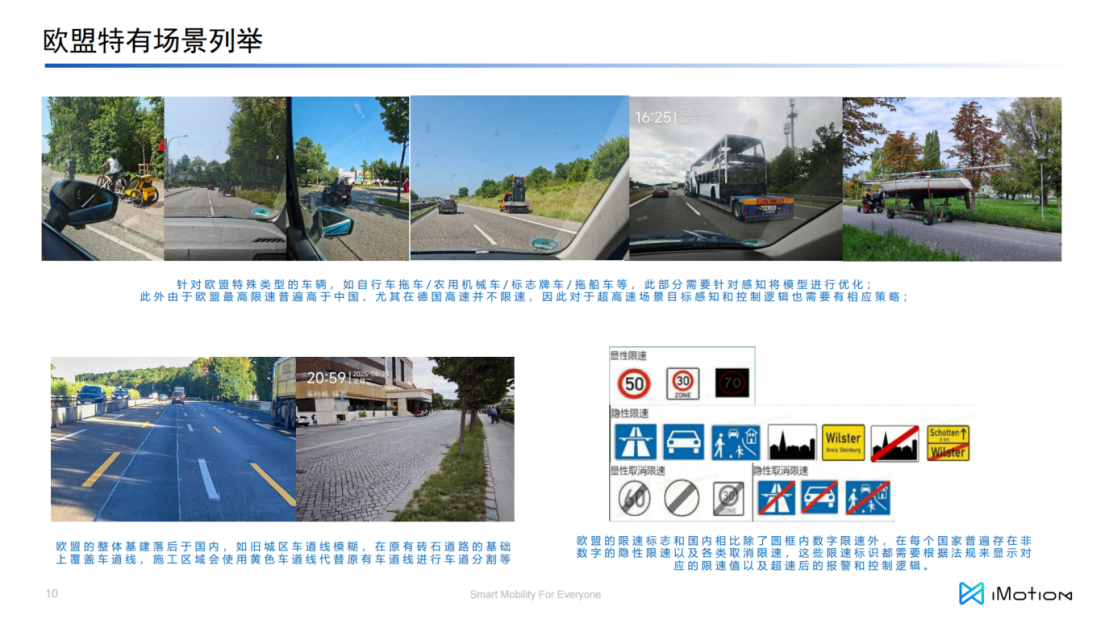
Differences in driving scenarios are equally significant. Zhang Wei gave an example: "In Europe, lane lines might be narrower. In the Middle East, there are ceramic nail lane lines." In Germany, speed-limit-free highways impose higher demands on planning and control algorithms. Various types of unconventional vehicles overseas – such as cars towing boats, cars towing small vehicles, or oddly shaped bicycles – all pose challenges to perception models.
Using the example of German construction zones, Huang Luoyi illustrated a deeper issue: "In areas without construction zones, the standard lane width is 3.75 meters. In construction zones, the yellow line width is only about 2/3 of the white line width. The car basically has to stay within the yellow line, with very little space left." This imposes entirely different requirements on perception and planning/control algorithms.
Even more challenging are differences in driving habits. Zhang Wei mentioned: "We were working on a project in Eastern Europe and found some of our functions were overly sensitive, constantly triggering alarms. Later, we discovered that locals drive very close to the car ahead and at high speeds." Bosch's Huang Luoyi pointed out that German traffic regulations explicitly require vehicles to slightly steer left when temporarily parked on the left side, and slightly steer right when parked on the right side, to leave space for emergency vehicles like ambulances and police cars – a "rule-based behavior" that is difficult for imitation learning trained on Chinese data to capture.
Huang Yinhua, Senior Solution Architect at HERE Technologies, offered a sharp assessment: "We can treat the map as a beyond-line-of-sight sensor. In areas where vehicle sensors cannot reach, the map can complete environmental understanding in advance, providing prior information for the algorithm." The map is not being marginalized; it is evolving from a navigation tool into the environmental foundation for intelligent driving systems.
HERE has launched a full-stack, layered map product portfolio covering L0 to L3, adaptable to different driving levels and the regulatory requirements of various countries. TomTom emphasizes that "mature autonomous driving should not just be about perception, but should anticipate road conditions like an experienced driver," its essence being "not just seeing the world, but understanding the world in advance."
Chinese algorithms excel in data scale and iteration speed, but overseas roads, signs, and driving habits constitute a completely new "examination system." In this system, Chinese intelligent driving needs to relearn.
"Just Go First" or "Be Ready Before Departing"?
Faced with the numerous challenges above, the paths for Chinese automakers' intelligent driving going global are clearly diverging.
Path One: Sell the cars first, then add features.
This is the real choice for most current Chinese automakers. Chen Yichi's observation is the most representative: "Given that intelligent driving in China hasn't yet achieved a closed business loop, investing heavily overseas doesn't seem very wise at this stage." Consequently, many domestic automakers choose to sell cars first and add intelligent driving features later.
Bosch's Huang Luoyi also acknowledged this reality: "Some friends might ask, can I have a set of algorithms strong enough to generalize globally? At least from our current understanding, we haven't found such an algorithm." Since one set of algorithms can't conquer the world, the strategy is to get a foothold first, then iterate.
Path Two: Systematic layout, all-in-one approach.
Chen Long, Senior Expert in Intelligent Driving Products at Great Wall Motors, represents a different line of thinking: "By faithfully serving users from their perspective, not playing tricks, and creating value for them, the enterprise itself becomes valuable." He emphasized that all of Great Wall Motors' technological deployments are centered around the user experience.
Huang Ziliang used a clever metaphor to express this idea: "In China, we must first cultivate large models based on domestic computing power, including Huawei, Horizon Robotics, and Black Sesame Technologies, let them blossom and bear fruit, and then promote them globally. It's not about planting the seeds of Chinese models on foreign computing power. It's like the lychees from Chang'an – you transport the soil and the lychees from Lingnan to Chang'an, rather than planting lychee seeds in Chang'an's soil. Those seeds won't grow or thrive."
TomTom's Chen Weicheng provided a framework from another dimension: "Compliance determines entry, scale determines breadth, and trust determines how long you can last." He advocates entering different markets in stages – first breaking into relatively less regulated markets like the Middle East and Southeast Asia, then tackling high-barrier markets like Europe.
Path Three: Leverage external forces.
Du Jianing suggested learning from "the joint-stock approach traditional foreign companies used when entering China." Bosch demonstrated the technical path of "federated learning" – data does not leave the country, only model parameters are exchanged. HERE has partnered with over 30 Chinese OEMs, providing global capabilities and ecosystem support.
Zhang Wei from知行科技 gave the most pragmatic summary: "On one hand, we are going global alongside automakers; on the other hand, we have also established relationships with many overseas OEMs, allowing us to apply our technology under them." Follow the lead, but also walk your own path.
Conclusion
Back to the initial question: Intelligent driving going global, just go first?
The answer is: Go first, but don't just "figure it out later."
"Going first" is correct – with China exporting 4.059 million vehicles from January to May 2026, staying put means missing a historic window. Europe has surpassed the Middle East to become China's largest automobile export region, accounting for about 25%. The competitive logic of Chinese automobile exports is shifting from "competing on batteries" to "competing on AI." At this turning point, any hesitation could mean falling behind.
But "don't just figure it out later" is equally important. Compliance is not something to "figure out later" – GSR, GDPR, and the UN R series regulations constitute a "one-vote veto" threshold. Data localization is not something to "figure out later" – it determines whether algorithms can iterate locally and whether the user experience can improve locally. Scenario adaptation is not something to "figure out later" – it determines whether local users are willing to pay for your intelligent driving.
As Chen Weicheng said: "True going global is not just about entering the world, but having the ability to operate sustainably in the world." Going first takes courage; being able to operate sustainably is true capability.
Comments
0 comments