
L03 Arrives, Can Xiaomi Compete in the SUV Market?
If you only look at sales figures, the MONA M03 is the most successful car Xiaopeng has launched in the past two years, selling 175,300 units in 2025, accounting for over 40% of the group's total sales.
But the other side of the coin is that Xiaopeng's reliance on a single model has become too significant to ignore. In January 2026, M03 sales dropped to 6,722 units, and in February, only 4,375 units. Although sales rebounded quickly after the facelift, the concern that one model carries half the business still hangs overhead.
The MONA L03, set to launch in July, is Xiaopeng's card to try and solve this problem.
From Single Model Dependence to Product Matrix
The success path of the M03 is actually very clear: in the 120,000-160,000 RMB family sedan market, it differentiates itself with superior intelligence. Standard features across the lineup include high-level assisted driving, a smooth in-car infotainment experience, decent range, and an appropriate price point. The M03 hits the basic needs of a large number of young users for a sense of technology.
But the ceiling of a single model is also obvious. In Q1 2026, the sales fluctuation of the M03 made Xiaopeng realize that relying on just one car to carry the volume makes it too vulnerable to risks. The positioning of the L03 thus became clear: it is not a replacement for the M03, but the second pillar of the MONA family.
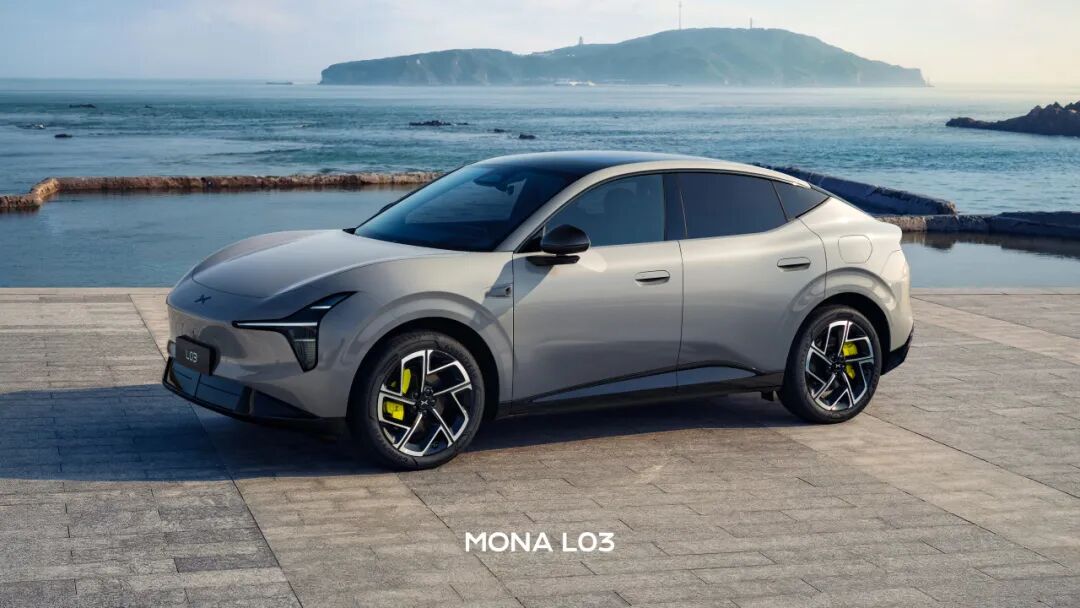
The M03 holds the sedan base, the L03 attacks the SUV incremental market, and a larger L05 will follow, gradually forming a tiered layout in the 100,000-200,000 RMB price range.
He Xiaopeng's statement on the L03 was very direct: the price will certainly not exceed 300,000 RMB, but the development standards are fully aligned with 300,000 RMB-class models, especially in the three dimensions of intelligent assisted driving, cockpit, and safety.
This strategy is exactly the same as the M03: using higher-level product capabilities to compete in a lower price bracket. The difference is that the M03 targeted the sedan market where competitors were relatively weaker, while the L03 is entering the SUV赛道, where there are many more and much stronger opponents.
How to Convince Young People to Spend Money?
The L03's strongest card is intelligent assisted driving. It comes standard with the VLA 2.0 pure vision assisted driving system, and the high-end version is equipped with the self-developed Ling chip, offering computing power of 750 TOPS for a single chip and 1500 TOPS for dual chips. Among 150,000 RMB-class SUVs, there is currently no other model that offers standard city navigation assist across the entire lineup. SUVs from Geely in the same price range mainly offer highway navigation assist, while BYD's city navigation assist requires an optional upgrade.
Range extension is another differentiating card. The L03 is the first model in the MONA series to offer both pure electric and range-extended versions. The range-extended version features a 1.5L range extender plus a 183kW motor, a 37.2kWh battery, a WLTC pure electric range of 241-257km, and a combined range of over 1000km.
In the same class, the Deepal S05 is only available in pure electric, and the Leapmotor C10 range-extended version has a WLTC pure electric range of only 210km. For users who have range anxiety but don't want to completely give up the electric drive experience, the L03's range-extended solution indeed hits the spot.
But with only these two cards, can it stand out? The answer is not that optimistic.
First, look at the competitors' base. The Yuan PLUS starts at 119,900 RMB and consistently sells over 30,000 units per month, relying not on fancy features but on BYD's brand recognition, channel density, and resale value.
The AION Y Plus starts at under 100,000 RMB and caters to both the ride-hailing and home markets. The Deepal S05 starts at 119,900 RMB, with a youthful design and decent features. These three models together basically lock down the mainstream customer base for 120,000-150,000 RMB pure electric SUVs. For the L03 to win customers from them, it needs to convince users that this car offers better value.
This logic holds up on paper. The L03 is commendable in terms of wheelbase and power; its intelligent assisted driving is even generationally ahead. But whether parameter advantages can translate into terminal sales depends on two things: first, whether the target users truly care about these parameters, and second, whether Xiaopeng's channels and brand can support this premium.
In the 100,000-150,000 RMB price range, consumers' decision-making logic tends to be more pragmatic. Is the range sufficient? Is the space large enough? Is charging convenient? Is the price right? These are the priorities. Intelligent assisted driving is a bonus, but not necessarily a deciding factor. The L03's pure electric version has a maximum range of 650km, and the range-extended version has a combined range of over 1000km. The data is not bad, but the gap with competitors is not as significant as it is for intelligent assisted driving.
Then there's the design. The L03 continues the MONA family's T-shaped starship light cluster, with an overall fastback coupe SUV silhouette. A 0.46 wheel-to-height ratio and 1.20 width-to-height ratio create a low stance. Elements like frameless doors and a panoramic cabin point towards a younger audience. This design language has already been validated on the M03 and has good acceptance. However, family design also means a discount on novelty. For young users seeking uniqueness, looking too similar to the M03 at first glance might not be a plus.
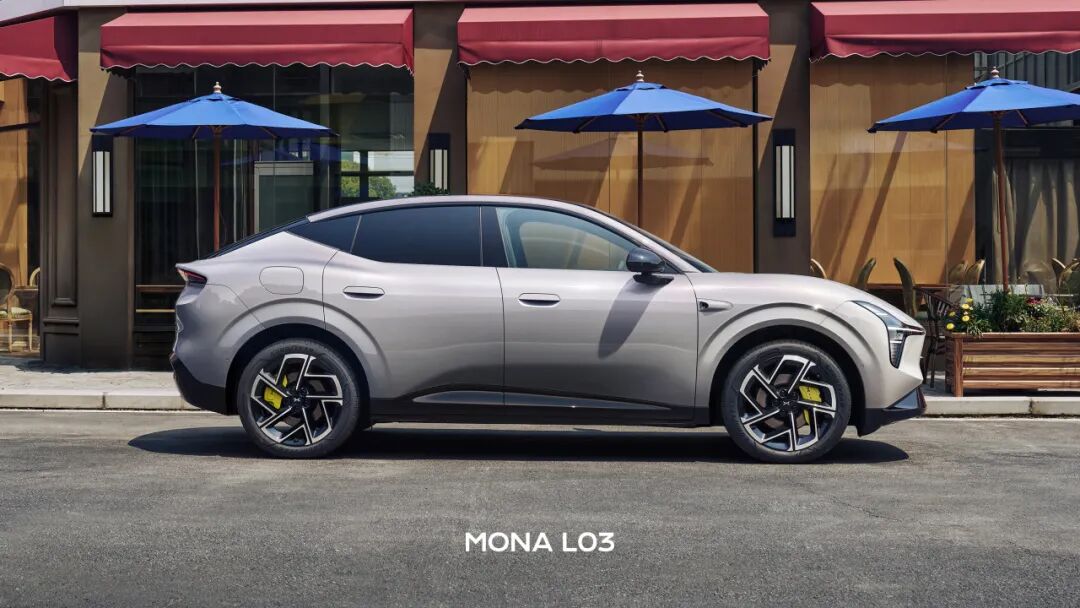
In terms of dimensions, the L03 measures 4650/4672×1920×1600mm in length/width/height, with a wheelbase of 2850mm. The pure electric version is equipped with a 183kW motor from Luxshare, offering 56kWh and 69kWh LFP battery options, with CLTC ranges from 505km to 650km. The range-extended version comes with a 37.2kWh battery, offering a WLTC pure electric range of 241-257km. The top speed for all versions is 180km/h.
For smart features, the VLA 2.0 assisted driving system is standard across the lineup. The Max version has a single Ling chip, while the Ultra SE version has dual chips. The cockpit is expected to run the Xmart OS. Optional extras include front dual cameras, fender cameras, a sport rear spoiler, various wheel styles, and brake calipers.
From the information disclosed so far, the L03's product strength is indeed impressive for its class. The wheelbase, motor power, intelligent assisted driving computing power, and range-extender option are all competitive individually. But parameter leadership doesn't equal market leadership. The Yuan PLUS sells over 30,000 units per month, relying not on spec sheet numbers but on years of accumulated user trust and channel coverage. For the L03 to replicate the M03's success in the SUV market, it faces stronger opponents, higher price points, and less room for error.
After its launch in July, the L03 will reveal its final pricing. If the starting price can be kept under 140,000 RMB, the discussion about its cost-effectiveness will be different. If it truly lands above 150,000 RMB, then it will depend on whether Xiaopeng's channel capabilities and brand appeal can support this 30,000 RMB premium.
Comments
0 comments